
Beyond the Blue Water: The Importance of Pool & Spa Inspections
In Los Angeles, a backyard pool is more than just an amenity; it is a lifestyle statement. From the classic kidney-shaped pools of the San Fernando Valley to the infinity edges of the Hollywood Hills, the shimmering blue water is often the emotional “closer” in a real estate deal. Buyers walk into the backyard, see the sparkling surface, and immediately picture summer barbecues and evening swims.
However, that sparkling blue surface is often an optical illusion. At Los Angeles Home Inspections CA, we know that a pool is essentially a complex, high-maintenance machine buried in the ground. It involves high-voltage electricity, pressurized plumbing, explosive gas heaters, and harsh chemicals—all mixing together in a concrete bowl that sits in seismic soil.
1. Safety First: The “Silent” Hazards
Before we look at pumps or heaters, our primary concern is safety. In Los Angeles County, drowning is a leading cause of accidental death for young children. A pool inspection is, first and foremost, a safety audit.
The Barrier Requirements
Does the pool have a compliant fence? Are the gates self-closing and self-latching? Do the doors leading from the house to the pool area have alarms? In many older LA homes, these features are missing or broken. We test every latch and alarm to ensure they meet current safety standards.
Suction Entrapment (VGB Act)
The single most critical safety check involves the main drains at the bottom of the pool. Old, flat drain covers can create a powerful vacuum seal if a swimmer’s body covers them, leading to entrapment and drowning.
We verify compliance with the Virginia Graeme Baker (VGB) Pool and Spa Safety Act. We look for modern, domed, anti-vortex drain covers that prevent this seal from forming. If we see a flat drain cover, it is an immediate “Urgent Safety Hazard” on our report.
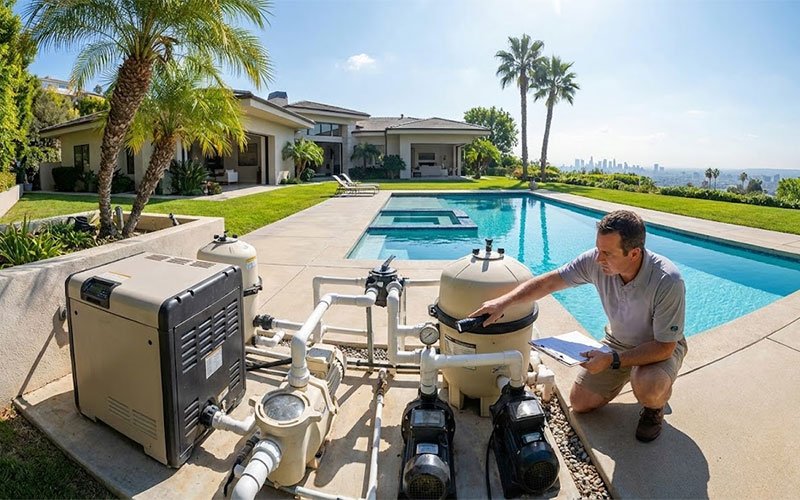
2. The Equipment Pad: The Heart of the System
The pool equipment pad is where the money is spent. A modern pool system can cost upwards of $15,000 to replace. We evaluate three main components:
The Pump
California Title 20 regulations now require variable-speed pumps for energy efficiency. Many older homes still run inefficient, single-speed pumps that act as energy vampires. We check for leaks at the shaft seal, noisy bearings (screaming sounds), and proper bonding.
The Filter
Whether it is DE (Diatomaceous Earth), cartridge, or sand, the filter is responsible for clarity. We check the pressure gauge—a high reading often indicates neglected internal grids or cartridges. A cracked filter tank is not just a leak; it is a pressurized explosion hazard.
The Heater
Heaters fail more often than any other component. We fire up the heater to check for ignition, but we also look for signs of “sooting” or corrosion on the burners. In LA, rodents love to build nests inside heater cabinets during the winter, which creates a significant fire risk when you turn it on in the spring.
3. The Structure: Cracks vs. Crazing
Los Angeles is earthquake country. Every pool here moves. The question is: has it moved too much?
The “Hollow” Sound (Delamination)
If you tap on the plaster with a specialized rod and hear a hollow “thud” instead of a solid “click,” the plaster is delaminating (separating) from the gunite shell beneath. While not a structural failure, it means the pool needs resurfacing—a project that starts at $10,000 for an average LA pool.
4. Electrical Safety: Water and Electricity Don’t Mix
This is the most technical part of our inspection. We check for two invisible life-savers:
- GFCI Protection: Underwater lights operate at 120 volts or 12 volts. If the seal fails and water touches the bulb, electricity enters the pool. A Ground Fault Circuit Interrupter (GFCI) cuts the power in milliseconds. We test these breakers to ensure they haven’t seized.
- Bonding (The Equipotential Grid): Have you ever touched a metal handrail in a pool and felt a tingle? That is a bonding failure. A thick copper wire must connect the pool water, the metal shell, the light niche, and the pump motor to equalize electrical potential. In many flipped homes, this wire is cut or disconnected, creating a shock hazard.
5. The Deck-O-Seal (Mastic)
Look at the gap between the concrete pool deck and the coping stones (the edge of the pool). There should be a flexible, rubbery sealant there called mastic.
Why it matters: This expansion joint allows the deck and the pool to move independently during an earthquake. If the mastic is dried out or missing, water from splash-out enters the gap. It then freezes (rare in LA) or causes soil expansion, which can heave the deck or crack the pool beam (the top 12 inches of the pool wall). Replacing mastic is cheap maintenance; ignoring it leads to expensive tile repairs.
6. Spas and Hot Tubs
Spas have their own unique issues. Because they operate at higher temperatures (100°F+), the chemistry is more volatile and corrosive. We often find that the blower motors (which create the bubbles) are seized from rust.
Additionally, the “Emergency Shut-Off” switch is a mandatory requirement for commercial pools but highly recommended for residential spas. If someone’s hair gets caught in a drain, this switch kills the pump instantly.
The Final Splash
A pool can be a private oasis or a money pit. The difference lies in knowing the condition before you close escrow. Whether the pool is empty, green, or crystal clear, it tells a story.
When you schedule your general inspection with Los Angeles Home Inspections CA, add the Pool & Spa package. We dive deep into the details so you don’t end up underwater on repairs.