
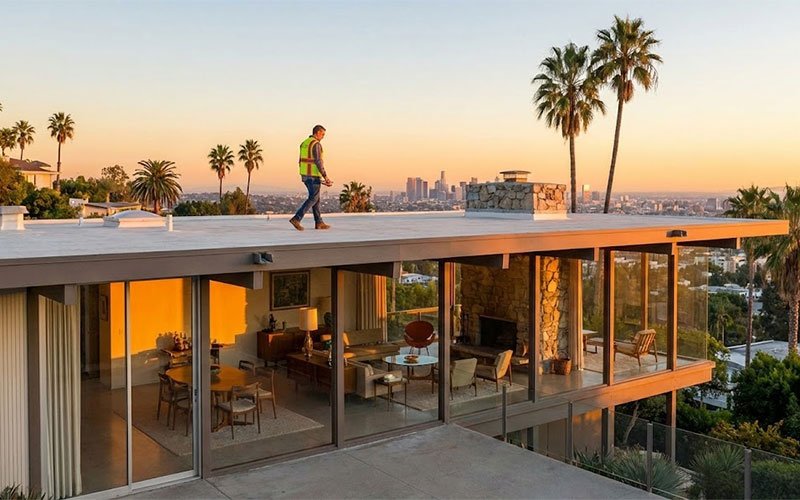
Mid-Century Moderns: What Hides Behind the Glass Walls?
From the cantilevered hillsides of Sherman Oaks to the quiet cul-de-sacs of Silver Lake, the Mid-Century Modern (MCM) home is the quintessential symbol of Los Angeles cool. Built largely between 1945 and 1970, these homes represent a radical departure from traditional architecture: floor-to-ceiling glass, flat roofs, and open “post-and-beam” floor plans that blur the line between indoor and outdoor living.
They are architectural masterpieces. They are also, strictly speaking, engineering experiments. At Los Angeles Home Inspections CA, we inspect hundreds of MCMs every year. While we admire the aesthetic, we are trained to look for the specific failures that occur when 1950s experimental materials meet 2020s reality.
1. The Flat Roof: A Bathtub in the Sky
The defining silhouette of a Mid-Century home is the flat or low-slope roof. In the 1950s, builders used “Tar and Gravel” (Built-Up Roofing). Today, these roofs present a unique set of challenges compared to the pitched roofs of Spanish or Craftsman homes.
Ponding Water: A flat roof is never truly flat; it should have a slight pitch to drains. Over time, support beams sag, creating low spots. When it rains, water sits in these depressions for days (ponding). This standing water degrades the roofing material rapidly, leading to leaks that go straight into your living room ceiling.
The Fix: Modern TPO or PVC single-ply membranes are far superior to the old tar systems. However, re-roofing an MCM often requires tapering the insulation to create artificial slopes for drainage.
2. The Glass Walls: Beautiful but Fragile
Those iconic floor-to-ceiling windows connect you with nature, but they disconnect you from modern energy efficiency and safety standards.
- Single-Pane Glazing: Most original MCM windows are single-pane. They have an R-value of roughly 1. In the summer, your home becomes a greenhouse. In the winter, it is a freezer.
- Annealed Glass (The Safety Hazard): Modern building codes require tempered (safety) glass in doors and large windows near floors. Original 1950s glass is often standard annealed glass. If a child (or an adult at a party) stumbles into it, it breaks into large, razor-sharp shards rather than small, safe crumbles.
3. The Electrical Panels: Fire Hazards in the Hallway
The post-war boom was a time of innovation, but not all innovations were good. Two brands of electrical panels common in this era—Zinsco and Federal Pacific Electric (FPE) Stab-Lok—are now known fire hazards.
4. The Sewer Line: Orangeburg Pipe
During the Korean War era (early 1950s), metal was scarce. Builders turned to Orangeburg pipe for sewer lines. This is essentially a tube made of wood pulp and hot tar.
The Reality: It was designed to last 50 years. We are now at year 70+. Orangeburg pipe collapses under the weight of the soil or is easily crushed by tree roots. It deforms into an oval shape, causing constant clogs. If your dream MCM was built between 1950 and 1960, a sewer camera inspection is non-negotiable.
5. Insulation (Or Lack Thereof)
Energy was cheap in the 1950s, and the climate crisis wasn’t a headline. Consequently, most Mid-Century homes have zero insulation in the walls. The “sandwich” roof decking (tongue-and-groove wood that serves as both the ceiling and the roof deck) leaves no cavity for insulation.
This means the beautiful wood ceiling you see inside is the only thing separating you from the sun beating down on the roof. Retrofitting insulation usually means adding rigid foam on top of the roof during a re-roofing project, which changes the profile of the fascia boards—a delicate aesthetic balance.
6. Hazardous Materials: Asbestos & Lead
The mid-century era loved synthetic materials. Unfortunately, many of them contained asbestos and lead.
- 9×9 Floor Tiles: If you pull up the carpet and find 9-inch square vinyl tiles, they likely contain asbestos.
- Acoustic Ceilings: The “popcorn” or “acoustic” spray-on ceilings common in late MCMs (1960s-70s) often contain asbestos.
- Mastic: The black glue used to hold down flooring is often asbestos-based.
These materials are generally safe if left undisturbed, but they make renovations expensive because they require professional abatement.
Buying the Dream
We are not here to talk you out of buying a Mid-Century Modern home. They are pieces of livable art. But owning art requires maintenance.
When you buy an MCM in Los Angeles, you are buying a lifestyle, but you are also inheriting a 70-year-old experimental structure. Our job is to make sure you know exactly what the restoration will cost, so you can preserve that California dream for the next generation.