
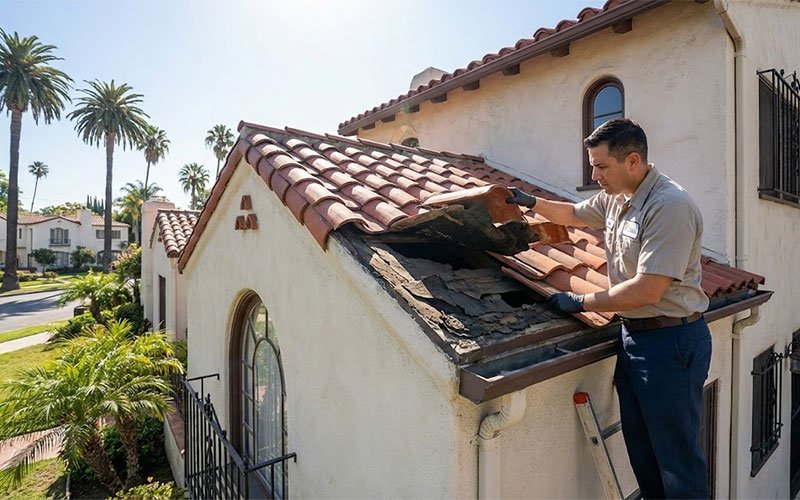
The Charm vs. The Challenge: Common Issues in 1920s Spanish Revival Homes
There is nothing quite like a 1920s Spanish Revival home in Los Angeles. From the red clay roof tiles of Los Feliz to the arched doorways of Hancock Park, these homes define the “Golden Age” of LA architecture. They are beautiful, romantic, and historically significant.
They are also, frequently, a financial nightmare for the unprepared.
At Los Angeles Home Inspections CA, we specialize in inspecting historic properties. We love these homes, but we inspect them with a critical eye because we know that 100-year-old construction methods rarely meet modern safety standards. If you are falling in love with a Spanish charmer, you need to look past the stucco and see the bones.
1. The Foundation: Gravity vs. Concrete
In the 1920s, concrete technology was different. Builders often used river rock aggregate, which resulted in a weaker concrete mix than we use today. Over a century, this concrete can become brittle.
More importantly, seismic codes did not exist as they do now. We frequently find two major issues:
- Lack of Bolting: The wood frame of the house sits on top of the concrete foundation. In 1925, gravity held it there. In 2024, we know that a major earthquake can slide the house right off the foundation. Retrofitting with seismic anchor bolts is often the first recommendation we make.
- Unreinforced Cripple Walls: The short walls between the foundation and the first floor act like shock absorbers. If they aren’t braced with plywood (shear walling), they can collapse during shaking.
2. The Plumbing: The Galvanized Time Bomb
If the plumbing in the home hasn’t been updated, it is likely galvanized steel. Unlike modern copper or PEX, steel rusts. But it rusts from the inside out.
You might see decent water pressure at the kitchen sink, but turn on the shower and flush the toilet at the same time, and the flow dies. This is because the internal diameter of the pipe is choked with rust buildup. Furthermore, as the pipe walls thin, they eventually leak—often inside walls or under the slab. Budgeting for a full re-pipe is a common reality for 1920s buyers.
The Sewer Line
Don’t forget the pipe leaving the house. 1920s homes used clay pipes for the sewer main. Clay is brittle and susceptible to root intrusion from those beautiful, mature trees lining the street. A “sewer camera inspection” is mandatory for any home of this age.
3. The Electrical: Knob and Tube Wiring
This is the deal-breaker for many insurance companies. “Knob and Tube” (K&T) was the standard wiring method until the 1940s. It consists of single-insulated copper conductors run within wall cavities, supported by ceramic knobs and passing through ceramic tubes.
4. The Chimney: The Unreinforced Widowmaker
That grand living room fireplace is the centerpiece of a Spanish Revival home. It is also, usually, a pile of unreinforced bricks. In the 1920s, masons didn’t typically run steel rebar vertically through the chimney structure.
In a significant seismic event, these heavy chimneys tend to snap at the roofline and fall—either through the roof into the living room or outward onto the patio. We often recommend a Level 2 chimney inspection to verify structural integrity.
5. Stucco and Drainage: The “Weep Screed” Issue
Spanish homes are famous for their thick stucco walls. However, in the 1920s, it was common practice to run the stucco all the way down into the dirt.
The Problem: Stucco is porous. When it touches the soil, it acts like a wick, pulling moisture up into the wall cavity (capillary action). This rots the mudsill (the bottom plate of your framing) and attracts termites. Modern code requires a “weep screed”—a metal flashing at the bottom of the wall that lets water out and keeps the stucco 4-6 inches above the soil. Retrofitting this can be labor-intensive but necessary to stop rot.
6. The Roof: It’s Not Just About the Tile
We’ve covered this in detail in other articles, but it bears repeating: The red clay tiles last forever; the black felt paper underneath them does not. On a 1920s home, we often find multiple layers of roofing or original paper that has turned to dust.
Don’t Buy Blindly
These homes are robust, beautiful, and worth saving—provided you know what you are getting into. A comprehensive inspection gives you the leverage to negotiate the price down to cover these necessary modernizations.
If you are looking at a historic home in Los Angeles, call the inspectors who know what lies beneath the plaster.