
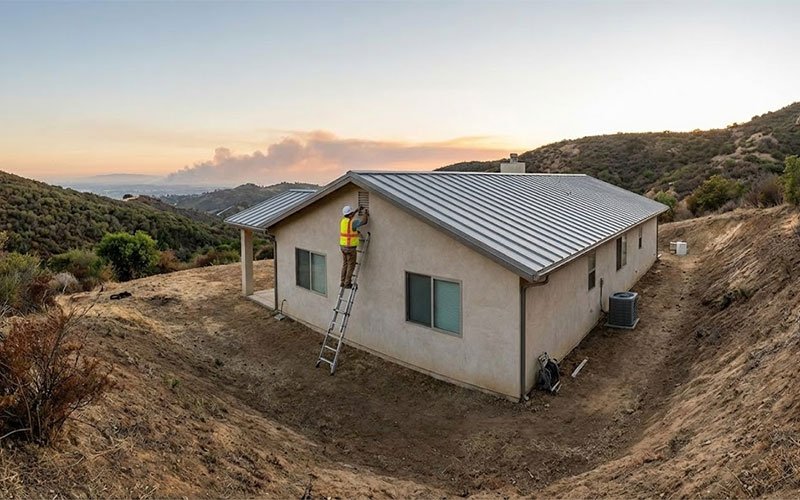
Wildfire “Hardening”: Is Your LA Home Built to Survive an Ember Storm?
In Los Angeles, “fire season” is no longer a season; it is a year-round reality. Whether you live in the canyons of Topanga, the hills of Hollywood, or the flatlands of the San Fernando Valley, the threat of wildfire is constant. But when most homeowners imagine a house burning down, they picture a 50-foot wall of flames marching up the driveway.
That is rarely how it happens. At Los Angeles Home Inspections CA, we know that the true enemy is much smaller, much quieter, and much easier to underestimate: the ember.
What is “Home Hardening”?
Home hardening is the process of retrofitting your property to resist these embers. It isn’t about building a concrete bunker; it’s about eliminating the small vulnerabilities that allow a single ember to burn down a million-dollar house. During our inspections, we look for three critical weak points that every LA homeowner should address immediately.
Weak Point #1: The Vents (The Hidden Highway)
This is the most common failure point we see in homes built before 2010. Your attic and crawlspace need to breathe, so they have vents. However, standard construction code used to require 1/4-inch mesh screens on these vents.
The Problem: A 1/4-inch hole is large enough for a burning ember to fly right through. Once inside your attic, the ember lands on your dry insulation or old cardboard boxes. The fire starts from the inside, often unnoticed until the roof collapses.
The Fix: Retrofit all attic, foundation, and eave vents with 1/8-inch or 1/16-inch non-combustible metal mesh. For high-risk areas in the Wildland-Urban Interface (WUI), we recommend specialized “ember-resistant” vents (like Brandguard or Vulcan) that use baffles to trap embers while allowing air to flow.
Weak Point #2: The Roof (The Landing Pad)
Your roof is the largest horizontal surface on your property. During an ember storm, it acts like a catcher’s mitt.
Most homes in Los Angeles have either asphalt shingles or Spanish clay tiles. Both can be fire-resistant (Class A), but they have different vulnerabilities:
- Asphalt Shingles: If the granules have worn off due to age, the asphalt underneath is highly combustible.
- Spanish Clay Tiles: These are excellent at stopping fire, but they have a fatal flaw: the “bird stop.” This is the gap between the curved tile and the flat roof deck at the eave. If this gap is not sealed with mortar or a metal bird stop, embers can blow underneath the tiles and ignite the felt paper below.
Weak Point #3: The Windows (The Heat Lens)
You might think the fire has to touch the glass to break it. In reality, the intense radiant heat from a nearby burning bush or neighbor’s house can cause standard window glass to shatter due to thermal stress. Once the window breaks, the fire enters your living room.
The Fix: All windows should be dual-paned with at least one pane of tempered glass. Tempered glass is heat-treated to withstand temperatures up to four times higher than standard annealed glass. If you are renovating, this is a non-negotiable upgrade for LA homes.
The “Zone 0” Concept: Defensible Space
California regulators have introduced a new concept called “Zone 0” or the “Ember-Resistant Zone.” This is the area within 5 feet of your home.
Decks and Patios
In the hilly terrain of Los Angeles, many homes have raised wooden decks. If you have stored old lumber, cardboard boxes, or dry leaves under your deck, you have built a bonfire under your house. We strongly recommend enclosing the underside of decks with 1/8-inch wire mesh to prevent debris and embers from accumulating underneath.
Conclusion: Hardening Buys Time
No home is 100% fireproof. However, a hardened home buys critical time for firefighters to save it. When a strike team drives down your street deciding which homes to defend, they look for the “winners”—the homes with clear defensible space, boxed eaves, and clean roofs. They are far more likely to park their engine in front of a hardened home than one that is already smoking from the eaves.
If you are buying a home in Los Angeles, do not ignore the “wildfire risk” section of your inspection report. The cost of retrofitting vents or replacing a window is small compared to the cost of losing everything.