
Seismic Retrofitting: Is Your Older LA Home Ready for “The Big One”?
Living in Los Angeles means accepting a certain level of geological risk. We enjoy the sunshine, the beaches, and the mountains, but we pay for it with the knowledge that the San Andreas, Newport-Inglewood, and Hollywood fault lines are active beneath our feet. For longtime residents, the 1994 Northridge earthquake is a vivid memory. For newcomers, “The Big One” is a vague threat.
But earthquakes do not kill people; buildings do. At Los Angeles Home Inspections CA, our job is to evaluate whether your home will protect you or endanger you when the ground starts shaking. If your home was built before 1980 (and especially before 1940), it likely has critical structural deficiencies that need to be addressed immediately.
The Three Points of Failure
When an un-retrofitted house faces lateral forces (side-to-side shaking), it tends to fail in three predictable ways. We check for all of these during our comprehensive inspections.
1. Sliding Off the Foundation (The Bolt Issue)
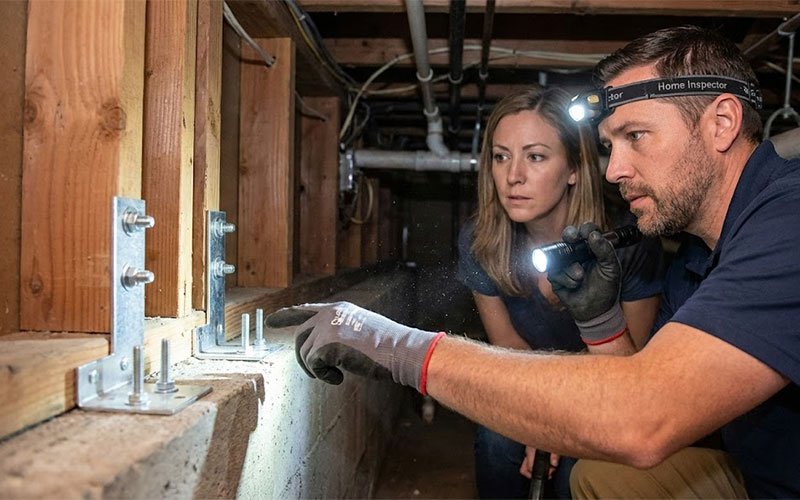
In homes built prior to 1940, builders often relied on gravity to keep the house on the concrete foundation. There are no bolts connecting the wood framing (the mudsill) to the concrete.
The Mechanics: When the earth moves sideways, the concrete foundation moves with it. The heavy wood house, however, has inertia—it wants to stay put. The result is that the foundation slides out from under the house. The house drops, severing gas lines, sewer lines, and electrical connections instantly.
The Fix: Retrofitting involves drilling into the foundation and installing heavy-duty steel expansion bolts or chemical anchors through the mudsill, effectively pinning the house to the ground.
2. The “Cripple Wall” Collapse (The Bracing Issue)
Many LA homes (especially Craftsman bungalows and Spanish Revivals) have a short wall between the foundation and the first floor. This is called a “cripple wall.” In older homes, these walls are just vertical 2×4 studs with exterior siding (stucco or wood).
The Mechanics: Without reinforcement, these vertical studs act like a row of dominos. Under lateral shaking, they tip over (rack), causing the house to crush the crawlspace. This is the most common cause of total home loss in earthquakes.
The Fix: We look for structural plywood sheathing nailed to the inside of these cripple walls. This creates a “shear wall” that is incredibly stiff and resistant to racking forces.
3. Post and Pier Failure
In hillside homes or older construction, the center of the floor is often supported by vertical wood posts resting on small concrete blocks (piers). If these posts aren’t strapped to the beams above them and the blocks below them, they can bounce out of place during vertical acceleration (the “jumping” motion of a quake).
The “Soft Story” Danger
This applies specifically to condos, apartments, or homes with a “tuck-under” garage (living space above the garage). Because the garage door requires a large opening, there is very little wall to support the heavy room above it.
In the Northridge quake, this was a catastrophic failure point. The garage walls collapsed, and the second floor pancaked onto the cars below. If you are buying a property with a room over the garage, we inspect the garage framing specifically for steel moment frames or heavy-duty shear paneling.
The Automatic Gas Shut-Off Valve
Fires following an earthquake often cause more damage than the shaking itself. Gas lines rupture, and sparks from severed electrical wires ignite the gas.
In the City of Los Angeles, it is mandatory upon the sale of a property to install a seismic gas shut-off valve. This small device sits on your gas meter. It contains a ball bearing that is dislodged by significant shaking, plugging the pipe and stopping the flow of gas automatically. We verify the presence and proper installation of this valve on every inspection.
Hillside Homes: A Special Category
If you are buying a home in the Hollywood Hills, Silver Lake, or Mount Washington, the physics are different. These homes are often built on stilts or caissons.
A standard retrofit (bolting/bracing) is insufficient here. These homes require complex engineering involving:
- Grade Beams: Reinforced concrete beams connecting the caissons.
- X-Bracing: Steel cables or rods forming an ‘X’ between the stilts to prevent twisting.
- Impact Walls: Protecting the structure from sliding soil.
For these properties, we often recommend a secondary inspection by a specialized Geostructural Engineer.
Chimneys: The Unreinforced Hazard
We see thousands of unreinforced masonry chimneys in LA. In a major quake, these heavy brick stacks snap. They do not just fall into the yard; they often fall through the roof or outward onto neighbors.
We check the attic to see if the chimney is strapped to the roof rafters. However, strapping only does so much. Many safety-conscious homeowners choose to remove the brick chimney entirely above the roofline and replace it with a lightweight metal flue framed in wood and stucco.
Peace of Mind Has a Price
A seismic retrofit is not a cosmetic upgrade. You won’t see it every day like a new kitchen counter. But it is the only upgrade that ensures you will have a kitchen counter after the next major event.
When you hire Los Angeles Home Inspections CA, we don’t just look for leaks and squeaky doors. We look at the structural bones of the house to ensure your investment—and your family—are secure on solid ground.