
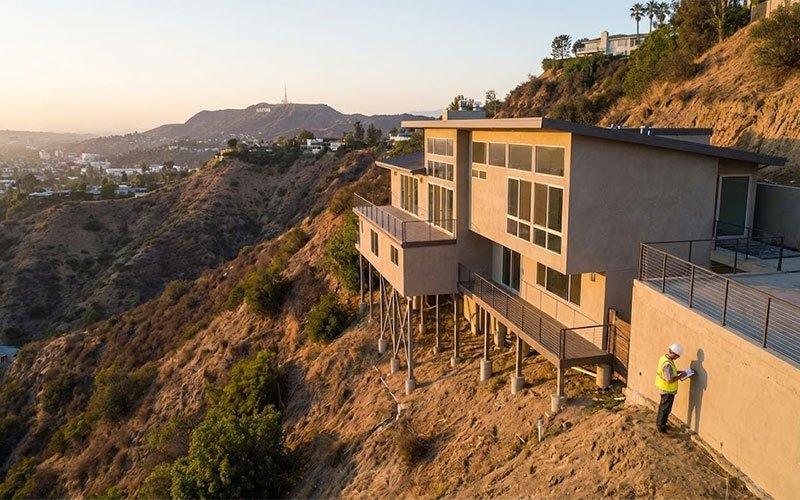
Hillside Living: The Unique Challenges of Inspecting Homes in the Canyons
There is a specific allure to Los Angeles canyon living. The winding roads of Laurel Canyon, the jetliner views from the Hollywood Hills, and the secluded privacy of Topanga attract buyers from all over the world. You are buying a view, a lifestyle, and a piece of the LA dream.
You are also buying a fight against gravity. At Los Angeles Home Inspections CA, we inspect homes on flat lots, and we inspect homes on 45-degree slopes. They are not the same animal. A hillside home is a complex feat of engineering that requires a specialized inspection approach to ensure the ground beneath your feet isn’t slowly sliding away.
1. The Foundation: Caissons vs. Stilts
Unlike a flat-lot home that sits on a slab, a hillside home must anchor itself deep into the bedrock. We typically encounter three types of foundations in the canyons, each with unique failure points:
The “Downslope” Home (Stilts)
These homes project out from the street, supported by tall columns. In older homes (pre-1970s), these might be simple steel pipes or wood posts resting on concrete pads. We check for:
- Rust and Rot: Are the steel supports corroded at the base? Is the wood touching soil?
- Cross-Bracing: Are there steel cables (X-bracing) connecting the stilts? Without these, the house can sway like a pendulum during an earthquake.
- Undermining: Has the soil eroded away from the concrete pads, leaving them “floating”?
The Caisson Foundation (Deep Piles)
Modern hillside homes sit on caissons—concrete pillars drilled 30+ feet into the bedrock. These are incredibly stable, but we check the “grade beams” that connect them. If the soil has moved away from the grade beam, you might see a gap between the ground and the house. This is actually a good thing (the house stayed put while the dirt moved), but it requires maintenance to prevent plumbing ruptures.
2. Drainage: The War on Water
Water is the enemy of any home, but on a hillside, it is lethal. If water saturates the soil, the soil gets heavy and slides. Controlling where the rain goes is the single most important maintenance task for a canyon homeowner.
The Roof Runoff: Where do the downspouts go? On a flat lot, they splash onto the grass. On a hillside, they must be piped to the street or a storm drain. If a downspout dumps water right next to the foundation, it can trigger a localized landslide.
The V-Ditch: Look up the hill behind the house. Is there a concrete channel (a V-ditch) to catch runoff from the neighbor above? These ditches often get clogged with leaves and mud. During our inspection, we walk the perimeter to ensure these interceptor drains are clear. If they overflow, that water ends up in your living room.
3. The Retaining Walls
A hillside property is usually a series of terraced steps held up by retaining walls. These walls are structural, not decorative.
4. The Sewage Ejector Pump
Physics dictates that water flows downhill. But if your home is downslope from the street, your toilets are below the city sewer main. You cannot rely on gravity.
These homes use a Sewage Ejector Pump. All the waste from the house collects in a tank, and a high-powered pump forces it up a pipe to the street.
The Inspection Reality: These pumps have a lifespan of 7-10 years. If it fails, sewage backs up into your lowest bathtub. We test the pump, the check valve (which stops sewage from flowing back down), and the high-water alarm. We always recommend installing a backup generator, because if the power goes out in a storm, you cannot flush your toilets.
5. The Deck: A Structural Wing
In the canyons, the deck is often the largest “room” in the house. It hangs out over open space, supported by cantilevers or posts.
We pay special attention to the Ledger Board—the piece of wood that attaches the deck to the house.
• Is it bolted or just nailed? (Nails pull out).
• Is there flashing to stop water getting behind it?
• Is there rot at the connection points?
A failed deck is a catastrophic event. If the deck feels “bouncy” when we walk on it, or if the railing wobbles, we will flag it as a major safety hazard.
6. Access and Insurance
While not strictly a “building defect,” access is a major factor in our report. Many canyon roads (like those in Nichols Canyon or Wonder View) are narrow, winding, and essentially one-lane.
The Geologist Recommendation
As general home inspectors, we look at the house. But we cannot see what is happening 50 feet underground. For hillside homes, we almost always recommend a secondary inspection by a Geotechnical (Soils) Engineer.
They can review city records for ancient landslides, test the soil density, and tell you if the hill itself is stable. We tell you if the house is broken; they tell you if the land is moving.
Buying the View, Knowing the Risk
Hillside living offers a tranquility you cannot find in the flatlands. The air is cleaner, the streets are quieter, and the views are unmatched. But these homes are high-performance machines that require proactive owners.
When you schedule an inspection with Los Angeles Home Inspections CA for a canyon property, you are getting an inspector who understands the difference between a settling crack and a structural failure. We help you distinguish between a manageable maintenance issue and a geological red flag.